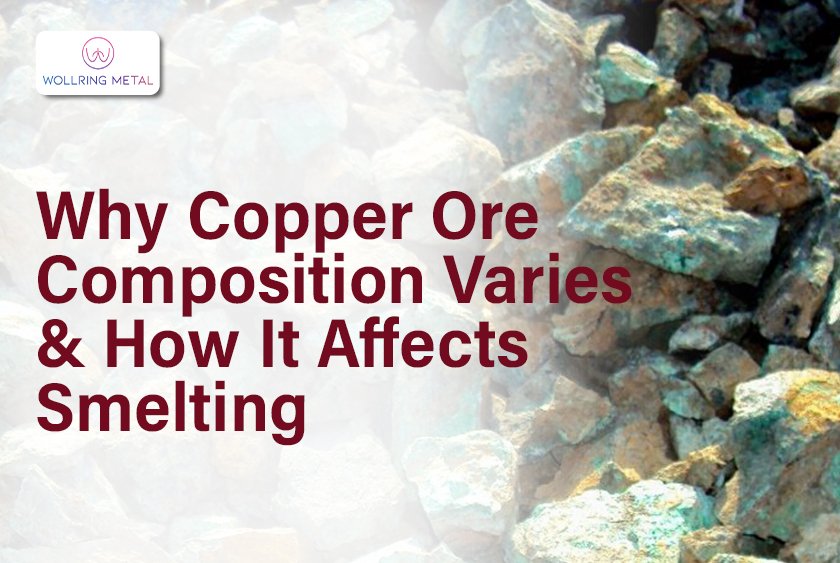
Why Copper Ore Composition Varies & How It Affects Smelting
When Your Copper Doesn't Smelt the Way It Should—The Hidden Chemistry Sabotaging Efficiency
Copper smelting isn't just a mechanical or thermal process—it’s a science that hinges on something deceptively simple: the composition of the ore itself. If you’ve ever wondered why one batch of copper smelts effortlessly while another resists every optimization, you’re not alone.
For procurement professionals, industrial metallurgists, or smelters dealing with low-grade, variable composition ores, the consequences of overlooking these differences are massive. Delayed operations. Higher costs. Wasted energy. Substandard copper.
Let’s break down why copper ore composition isn't just a background detail—it’s the silent force determining your operational success or failure. And why it’s reshaping how industries approach the copper smelting process today.
The Hidden Variability: Why Copper Ore Isn’t One-Size-Fits-All
Every copper ore deposit is shaped by geological processes over millions of years. That means no two loads are ever truly identical. The result?
A fluctuating copper ore grade, unpredictable mineralogy, and a blend of both smelt-friendly and smelt-resistant compounds.
There are two main types of copper ore that dominate commercial extraction:
- Sulfide Ores: Most commonly chalcopyrite and bornite, these are easier to smelt due to their thermal response.
- Oxide Ores: Like malachite and cuprite, which require different leaching processes and smelting techniques.
Misidentifying the types of copper ore in your procurement plan often leads to inefficiencies and mismatched processing techniques.
This variability isn’t rare—it’s standard. That’s why understanding copper ore mineralogy is your first line of defense against inefficiency.
Chalcopyrite vs Bornite: A Micro-Difference That Makes a Macro Impact
On paper, both minerals are copper-rich sulfides—but their behavior inside a smelter is entirely different.
- Chalcopyrite (CuFeS₂) is more stable at high temperatures and resists oxidation longer. It requires higher energy input for efficient smelting.
- Bornite (Cu₅FeS₄), on the other hand, reacts more readily and releases copper at lower thermal thresholds.
The chalcopyrite vs bornite dilemma is more than academic—it directly affects smelting efficiency, furnace calibration, and final yield.
So before you even start the copper smelting process, knowing what exactly you’re working with isn’t just helpful—it’s mission-critical.
Why the Ore Grade Isn’t the Whole Story—But Still Everything
The copper ore grade tells you how much copper is theoretically extractable, usually expressed as a percentage.
- High-grade ores (>1.5% copper) are economically ideal and smelt efficiently.
- Low-grade ores (<0.5%) pose challenges: higher fuel costs, more waste, and lower recovery rates.
Yet even among ores of the same grade, differences in copper ore composition can dramatically alter results.
This is where mineralogical insights bridge the gap between what the numbers suggest and what your smelter will actually yield.
The Nightmare of Smelting Low Grade Copper Ore
Smelting low-grade ore is like trying to light wet wood. It takes more fuel, more time, and the result is subpar.
Here’s the reality:
- The gangue material (non-copper minerals) dominates the mass, diluting the thermal reactions.
- Additional fluxes and reagents are needed to modify slag chemistry.
- Yields are lower, while energy consumption surges.
The difficulty of smelting low grade copper ore is compounded when you're dealing with uncharacterized mineral variations and shifting oxidation profiles.
Unless you tailor your process around the specific composition of the ore, you're simply burning money—literally and figuratively.
The Role of Copper Ore Mineralogy: Your Invisible Risk Factor
Copper ore mineralogy dives deeper than grade or classification. It examines:
- Crystallinity and grain structure
- Presence of secondary minerals that may trap copper during smelting
- Trace impurities like arsenic, which can wreak havoc in refining
These mineralogical factors often go unnoticed, but they significantly alter how ore behaves in the smelter.
Even in high-grade ore, failure to analyze mineralogy often results in copper losses, increased slag volume, and inconsistent refining outputs.
How Copper is Extracted from Ore—And Why It’s Not the Same Every Time
The general process is known: crush, grind, concentrate, smelt, and refine. But depending on ore composition, the smelting stage undergoes major adjustments.
For sulfide ores:
- Roasting is often required to drive off sulfur and oxidize iron.
- Smelting then separates the matte from slag.
For oxide ores:
- The extraction leans more toward leaching and SX-EW (solvent extraction-electrowinning) rather than high-temperature smelting.
Understanding how copper is extracted from ore across these different mineralogical categories is crucial—not just for technical teams but for procurement and planning units as well.
Meaning: Your extraction process must fit the ore, not the other way around.
When One Solution Makes It All Seamless
Industries operating on thin margins and tight schedules can’t afford inefficiencies caused by mismatched ore treatment. This is where deep ore analysis, adaptive smelting practices, and consistent sourcing protocols become game changers.
The solution isn’t more processing—it’s more precision, especially in how you interpret types of copper ore, composition, and the smelting strategy they demand.
Case Study: When One Misjudged Shipment Cost a Smelter $1.4 Million
A mid-sized refinery in Northern Europe received a 500-ton shipment labeled as “standard chalcopyrite.” What it actually contained was 40% bornite and trace oxide minerals.
The result?
- Slag contamination exceeded acceptable thresholds
- Copper recovery dropped 12%
- A 6-day emergency system recalibration cost $1.4M in downtime and corrective logistics
This could’ve been avoided with comprehensive ore composition analysis and adaptive smelting strategy—two things now embedded in the company’s procurement protocol.
Recent News & Trends in Copper Smelting and Ore Composition
- May 2025: Chilean miners adopt AI-driven mineralogy mapping to forecast smelting efficiency before shipping—transforming the way they handle copper ore mineralogy at scale.
- April 2025: A new research study from the University of Queensland proves that early mineral composition modeling can increase copper yield by 18%, particularly for low-grade ore.
- March 2025: Global copper producers report rising inefficiencies due to mismatched copper smelting process approaches—especially with complex ore compositions sourced from Africa.
Conclusion: Precision Is No Longer Optional—It’s the Only Path Forward
Understanding the composition of copper ore is no longer just a geological curiosity—it is now a commercial imperative. The more precise your knowledge, the more efficient your extraction, the higher your yield, and the more predictable your margins.
And while much of the industry still plays catch-up, WOLLRING METAL has long positioned itself at the intersection of deep mineral intelligence and optimized global supply systems. Whether it’s dealing with complex ore compositions, low-grade challenges, or scalable smelting support, it delivers not just material—but mastery over the material’s behavior.
It’s not just about buying copper. It’s about understanding it—before it even enters your furnace.